

Executive Summary: An Unprecedented Cosmic Delivery
In what researchers are describing as an extraordinary stroke of scientific fortune, a space rock that violently crashed through a residential bedroom ceiling in Hillsborough, New Jersey, has yielded unprecedented clues about the precursor chemical conditions required for life. Advanced laboratory analyses of the recovered meteorite have revealed the presence of hundreds of distinct amino acids—the foundational organic building blocks of proteins and cellular structure. Astrobiologists confirmed that a substantial majority of these specific amino acid compounds do not occur naturally anywhere on Earth, confirming their primordial, deep-space provenance.
The remarkable fallout from this rare atmospheric event provides direct evidence that complex organic molecules formed in cosmic environments long before our planet took shape. By studying the pristine fragment before extensive terrestrial contamination could take place, international research teams have gained an unaltered look into the volatile chemistry of the early solar system.
The Collision: From Outer Space to a New Jersey Suburb
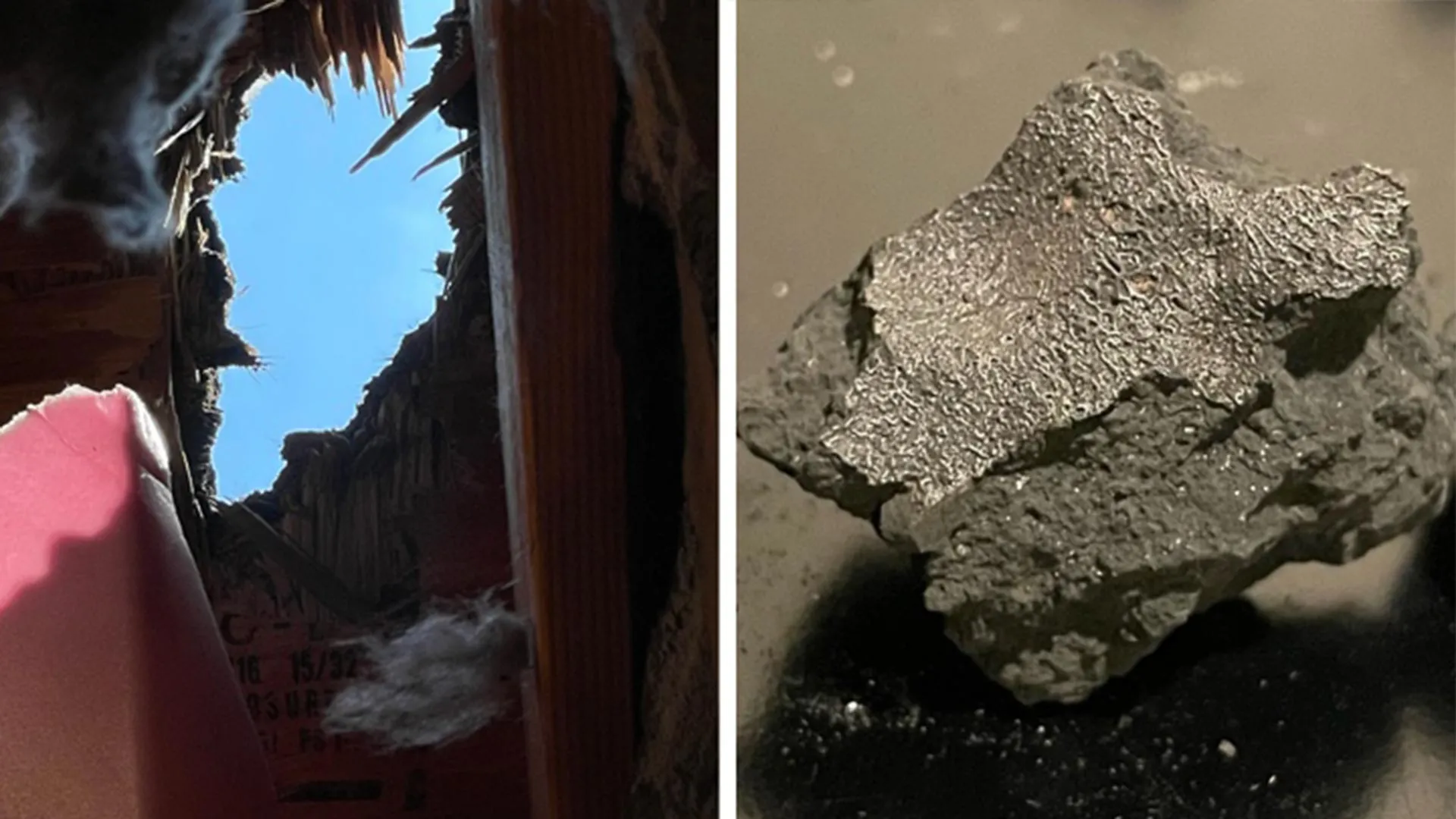
The story began unexpectedly in 2024 when residents in Hillsborough Township, New Jersey, were startled by a sudden impact that penetrated their home's roof and bedroom ceiling. Emergency services and local researchers quickly secured the site, identifying the dense dark projectile as an stony-iron chondrite meteorite that had survived high-speed transit through Earth's upper atmosphere.
Because the specimen was retrieved shortly after impact, scientists were presented with a rare opportunities: inspecting a fresh extraterrestrial sample that had experienced minimal exposure to Earth's moisture, biological organisms, and atmospheric pollution. Upon transfer to specialized cleanroom facilities, research institutions subjected thin sections of the rock to high-resolution mass spectrometry and liquid chromatography.
Chemical Revelation: Exotic Amino Acids Uncovered
The results of the laboratory investigation exceeded initial expectations. While scientists have previously identified simple organic matter in space debris, the Hillsborough meteorite contained a remarkably dense and complex spectrum of chemical compounds. Laboratories identified hundreds of unique amino acid structures within the meteorite's porous matrices.
Crucially, while life on Earth relies primarily on a standard set of 20 amino acids to construct proteins, the meteorite contained scores of rare, non-proteinogenic amino acids. The molecular configuration and isotopic signatures of these compounds confirm that they formed through non-biological chemical synthesis inside ancient asteroids billions of years ago.
"Finding hundreds of unique amino acid variants inside a single meteorite recovered straight from a residential site is extraordinary. The fact that the majority of these organic compounds do not exist naturally in Earth's biosphere proves that the solar system was teeming with complex prebiotic chemistry before planets even fully formed."
Implications for Astrobiology and the Origins of Life
The discovery strongly reinforces the theory of molecular panspermia—the idea that the essential chemical ingredients for life were delivered to the young Earth via continuous impacts from meteorites, comets, and asteroids. During the early bombardment phase approximately 4 billion years ago, thousands of similar space rocks rained down across early terrestrial oceans.
Key Findings from the Hillsborough Meteorite Sample:
- High Molecular Diversity: Hundreds of distinct amino acid species were cataloged, displaying a level of structural diversity rarely documented in land-based recoveries.
- Extraterrestrial Provenance: Isotopic ratio measurements of carbon and nitrogen confirmed that the organic compounds formed in interstellar ice grains or parent asteroid bodies prior to entering Earth's orbit.
- Pristine Condition: Rapid recovery prevented terrestrial soil bacteria and humidity from degrading or contaminating the fragile organic signature inside the meteorite's interior.
Researchers note that these Findings provide a crucial baseline for ongoing space missions, such as NASA's OSIRIS-REx and JAXA's Hayabusa2, which brought asteroid samples back directly from orbit. Comparing sample returns gathered in zero gravity with freshly fallen meteorites like the Hillsborough rock allows scientists to better calibrate how atmospheric entry impacts organic matter.
Strategic Analysis & Future Laboratory Outlook
Moving forward, multidisciplinary teams plan to conduct micro-beam spectroscopic mapping to understand how these amino acids interacted with minerals inside the parent asteroid. By mapping where organic molecules cluster relative to hydration minerals and metallic grains, geochemists hope to reconstruct the thermal and water-based history of the original celestial body.
As analytical instruments become increasingly sensitive, discoveries like the Hillsborough meteorite continue to transform our understanding of cosmic chemistry. Far from being dead rocks wandering through dark space, asteroids appear to act as cosmic laboratories, manufacturing and preserving the basic blueprints necessary for biological evolution.
News & Media Credits: Information and media compiled from verified reports by ITVX, Space Daily, and ScienceDaily. Image rights retained by respective publishers.